
Levels of Evidence in Medicine
Every time a doctor prescribes a treatment, they rely on their experience. But what if there was a way to make the choice more precise and reliable? That way is evidence-based medicine. It is needed to separate effective treatments from ineffective ones, based not on opinion, but on scientific facts.
Simply put, evidence-based medicine is a tool that helps the doctor and patient make the best decision. It answers the main question: 'Does this treatment work and is it safe?'
It's important to understand: the reliability of evidence in medicine is determined by two key factors that must be assessed simultaneously:
-
Study Type (Design): This is how the study was conducted (e.g., expert opinion, cohort study, or randomized controlled trial). Different study types have different abilities to prove a cause-and-effect relationship.
Usually, the study type is indicated at the beginning of a scientific article (e.g., in the title or abstract) or in a special section 'Materials and Methods'. Look for words like: Randomized Controlled Trial (RCT), Systematic Review, Meta-analysis, Cohort study. -
Quantity and Quality of Data: This includes the sample size (how many people participated), as well as how well the study itself was conducted (adherence to protocol, absence of errors).
Thus, the strongest evidence will come from a high-level study (e.g., a systematic review, meta-analysis, or RCT) involving a large number of people (ideally thousands), and which was conducted in compliance with all scientific standards. Both of these factors form the level of evidence for making a clinical decision.
Study Types (Designs) and Their Levels of Evidence
Not all scientific data is equally valuable. Evidence can be divided into levels—from the lowest to the highest. It's like a pyramid: the higher the level, the more reliable the data.
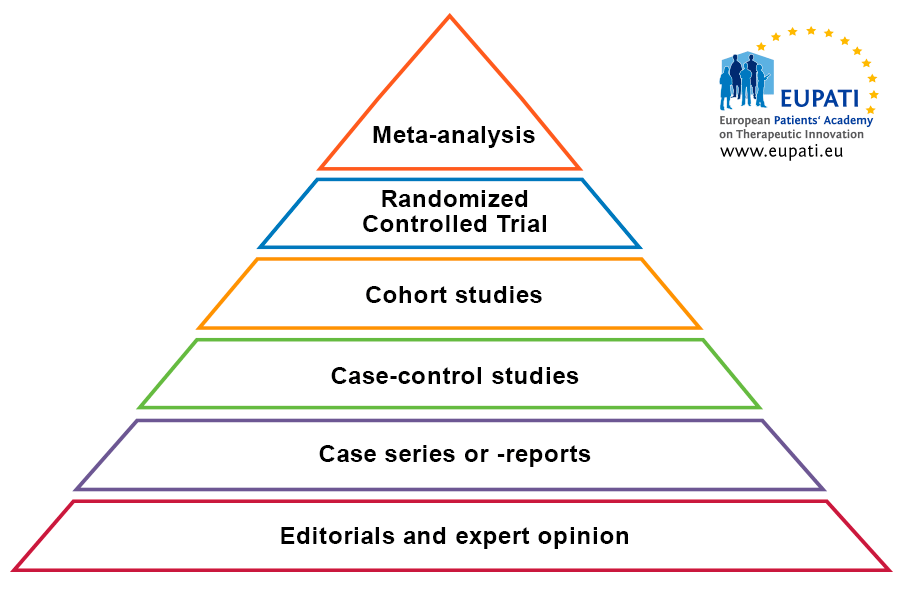
Level 1A: Meta-analyses of RCTs
Description: This is the pinnacle of the evidence pyramid. A meta-analysis combines statistical data from multiple randomized controlled trials (RCTs) to obtain a single, more precise overall result.
Level of Evidence: Very High
Level 1B: Randomized Controlled Trials (RCTs)
Description: Study participants are randomly divided into two groups: one receives the new treatment, and the other receives a placebo or standard treatment. This allows for the maximum exclusion of other factors and proves that it was the new treatment that worked.
Level of Evidence: Very High
Level 2A: Systematic Reviews of Cohort Studies
Description: A systematic review is a thorough analysis and summary of data from all cohort studies on a specific topic. It provides a more complete picture than a single study.
Level of Evidence: High
Level 2B: Cohort Studies
Description: Observe a group of people (a cohort) over a long period to see who gets sick. Can show an association between a factor and a disease.
Level of Evidence: Moderately High
Level 3A: Systematic Reviews of Case-Control Studies
Description: A summary of data from case-control studies. Provides more reliable conclusions than a single case-control study.
Level of Evidence: Moderate
Level 3B: Case-Control Studies
Description: Compare a group of sick people with a group of healthy people to find common features in their past (e.g., whether they smoked). Can show a correlation, but cannot prove a cause-and-effect relationship.
Level of Evidence: Moderately Low
Level 4: Case Series / Case Reports
Description: A description of several cases of a disease or treatment. For example: 'We observed 10 patients with similar symptoms.' Useful for generating hypotheses, but not for making decisions, as there is no control group.
Level of Evidence: Low
Level 5: Expert Opinion
Description: This is the lowest level. It is based on a doctor's personal experience without systematic data analysis. For example: 'In my experience, this treatment works.'
Level of Evidence: Very Low
Where to Find Evidence Information
To understand how reliable a study is, you need to find three things:
- The study type (design), indicated at the beginning of the scientific article.
- The number of participants.
- Where to check the assessment: The level of evidence is usually not assigned to a single article. It is given to a specific recommendation or conclusion based on the analysis of all currently available studies. To find this information, you should look not for the original studies, but for:
- Systematic reviews and meta-analyses: This is the best source. Their conclusion or 'Results' section often indicates the level of evidence assigned to the findings.
- Clinical guidelines: These documents, created by professional societies (e.g., the European Society of Cardiology), contain clear recommendations with their level of evidence and strength.
- Specialized databases:
- The Cochrane Library – a world leader in systematic reviews. Each review has a 'Certainty of Evidence' section that uses the GRADE system.
- The Guidelines International Network (GIN) database – allows you to find guidelines from around the world with an assessment of their quality.
Key takeaway: For treatment decisions, rely on systematic reviews and RCTs. They contain the most reliable data. Always look for studies with a large number of participants, published in peer-reviewed journals, and conducted using rigorous scientific methods.